The Human Experience of the Solar Eclipse
Total solar eclipses, like the one coming up Monday April 8th, have long captivated the imagination of humanity. Across cultures and centuries, these celestial events have been wrapped in profound symbolism, inspiring myths, legends, and folklore that endure through the ages. As the moon momentarily obscures the sun, darkness descends, and the world is enveloped in an eerie twilight. This cosmic spectacle has sparked awe, fear, and wonder, giving rise to legends and folklore that reflect the human fascination with the heavens.
Legends Unveiled
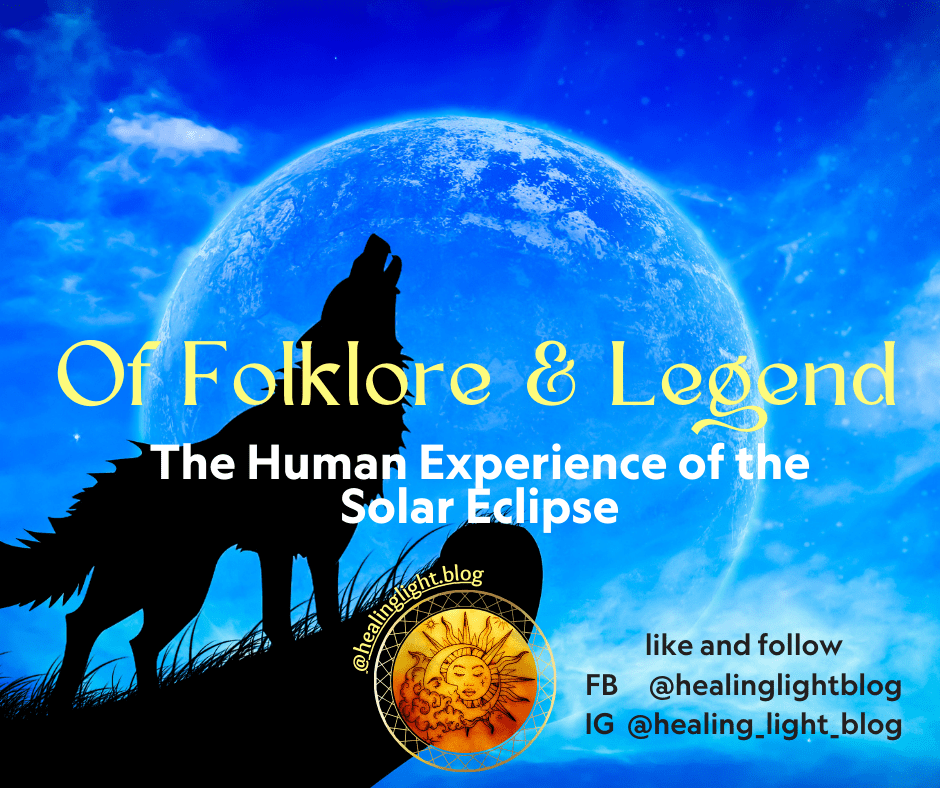
In ancient civilizations such as those of the Maya, Inca, and ancient Chinese, solar eclipses were often interpreted as cosmic omens or the result of mythical beings temporarily devouring the sun. In Norse mythology, it was believed that the sun was chased by wolves, and during an eclipse, one of these celestial predators caught up, causing darkness to fall upon the land.
In Hindu mythology, the demon Rahu was said to swallow the sun during eclipses, only to release it soon after, unable to consume it completely due to divine intervention. Similarly, in Greek mythology, the eclipse was attributed to the sun god Helios temporarily withdrawing his light, while in Egyptian mythology, it symbolized a battle between the gods Ra and Apep.
Across cultures, there is a shared theme of celestial conflict or disturbance during eclipses, reflecting the fear and awe evoked by these rare events.
Cultural Significance
Beyond their mythological interpretations, solar eclipses have also held deep cultural significance. In many indigenous cultures, eclipses are seen as moments of spiritual renewal or opportunities for introspection and meditation. They mark occasions for rituals, prayers, and communal gatherings, as people seek to harness the spiritual energies believed to be present during these celestial alignments.
In some cultures, eclipses are associated with societal changes or political upheavals. Historical records indicate that the ancient Chinese believed that solar eclipses foretold the downfall of a ruler or the rise of a new dynasty, while the Aztecs saw them as signs of impending doom or transformation.
Scientific Enlightenment
While ancient civilizations viewed eclipses through the lens of mythology and mysticism, modern science has provided a deeper understanding of these phenomena. Through observation and mathematical modeling, astronomers can predict the occurrence of eclipses with precision, demystifying what was once considered supernatural.
Yet, even in the age of scientific enlightenment, the allure of eclipses persists. People around the world still flock to witness these rare events, not only for their scientific significance but also for the sense of wonder and awe they inspire. News outlets across the United States are talking about the path of the upcoming Eclipse and comparing it to the previous one in 2017. Weathermen for stations along the eclipse path are including the anticipated cloud cover in their forecasts. Amazon is promoting Eclipse Glasses and hotels along the eclipse path are already booked to capacity. In an era dominated by technology and rationalism, solar eclipses bring us back to the enduring mystery and beauty of the universe.
Total solar eclipses transcend the boundaries of time, culture, and belief, weaving a tapestry of legends and folklore that reflect humanity’s enduring fascination with the skies. From ancient myths of celestial conflict to modern-day celebrations of scientific discovery, eclipses continue to captivate our imagination and inspire wonder. And Monday’s eclipse is all that much more special in the states, knowing that the next total eclipse visible in the US will not occur for another 20 years.
So if you are in the path of this eclipse, make your plans to get outside (with proper eye wear) on Monday. At the appointed hour, gaze upon the darkened sky and allow your mind to reveal in the moment, allowing your spirit the space and time to deeply feel the vastness and complexity of the universe, and our place within it.
 Healing Light
Leave a comment