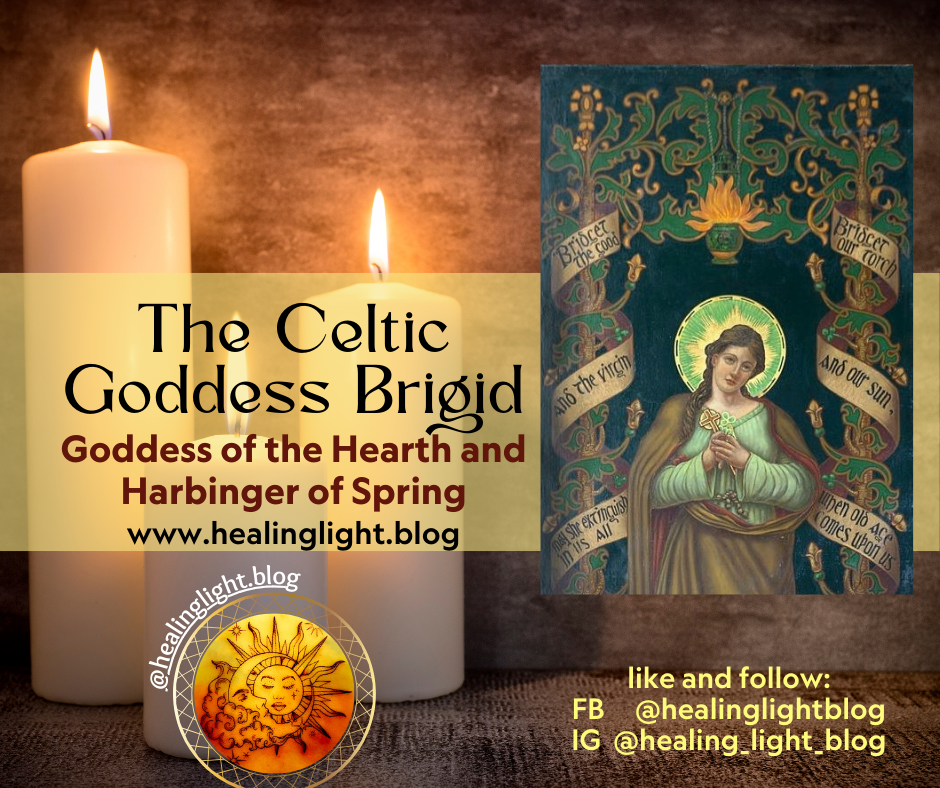
Goddess of the Hearth and Harbinger of Spring
Today is Imbolc, the midpoint between the winter solstice and the spring equinox. This is a time of stirring, of potential, and of the first whispers of new life. For a little history of this holiday and tips for celebrating, you can check out my earlier posts Honoring Imbolc and Celebrating Imbolc. Today, however, we’re covering the Goddess Brigid and her part in this special time.

The festival of Imbolc is deeply intertwined with the Celtic goddess Brigid, a figure of immense power and influence, embodying learning, healing, the craft of the blacksmith, and fertility. Unlike deities tied to specific locales, Brigid’s worship spanned the breadth of the Irish-Celtic world, reflecting her significance.
Brigid was more than just a goddess; she was a bringer of civilization, credited with bestowing knowledge and skills upon the Celtic people. Imagine her surrounded by her all-female priesthood, a sacred flame burning in their midst, echoing the Roman Vestal Virgins. At the heart of winter, festivals in her honor implored the return of spring, a vital cycle of renewal.
Imbolc carries a threefold significance, each facet reflecting Brigid’s multifaceted nature:
- The Sacred Union of Fire and Water: Brigid’s association with both the forge’s fire and Ireland’s waterways speaks to her command over the elements of creation and transformation. The blacksmith’s fire, shaping raw materials into tools and art, mirrors the flow of water, life-giving and ever-changing.
- The Quickening of Life: As a goddess of fertility, Brigid is deeply associated with the beginning of life within the womb, both human and animal. The seeds of the previous harvest, held dormant through winter, are now sown, a potent symbol of rebirth and the promise of abundance. This speaks not only to the literal planting of seeds but also to the metaphorical planting of intentions and dreams.
- The Ewes’ Lactation: In the agriculturally driven societies of medieval Europe, the ability of ewes to provide milk was crucial for survival. By mid-winter, stores from the autumn harvest were dwindling, making the milk, cheese, and butter from newly lactating animals a vital food source. This association highlights Brigid’s role in ensuring the sustenance and well-being of her people.
Imbolc, as a season in its own right, is a time of transition. As we approach the spring equinox, the days grow longer, the sun’s strength increases, and the earth begins to awaken. Ancient Celtic traditions included lighting fires to warm the frozen ground, hanging Brigid’s Crosses, woven with four arms, above doorways for protection and blessing, and practicing weather divination to foresee the coming seasons. Much like our modern Groundhog’s Day, the Celts looked for signs of spring’s imminent arrival, listening for the song of the lark, a signal that the divine had reunited, and the season of growth was near.
The influence of Brigid was so pervasive that, with the rise of Christianity, she was not forgotten. Instead, she was embraced and transformed, becoming St. Brigid of Kildare, whose feast day also falls on February 1st. Her shrine, tended by nineteen nuns, echoes the traditions of her pagan priesthood, a testament to the enduring power of this goddess who bridges the ancient ways with the new.
What intentions or seeds are you sowing at this time as we approach spring? Share in the comments.
Light and Love ❤
Please consider hitting the like button and/or sharing!
#Imbolc #Brigid #GoddessBrigid #CelticGoddess #Paganism #Witchcraft #WheelOfTheYear #SpringEquinox #WinterSolstice #FireFestival #FertilityGoddess #HealingGoddess #Smithcraft #BrigidsCross #IrishMythology #CelticTraditions #StBrigid #Candlemas #NewLife #Rebirth #PaganBlog #Metaphysical #Spiritual #Divination #GroundhogDay


 Healing Light
Leave a reply to Ashley Cancel reply